arrow_backAll episodes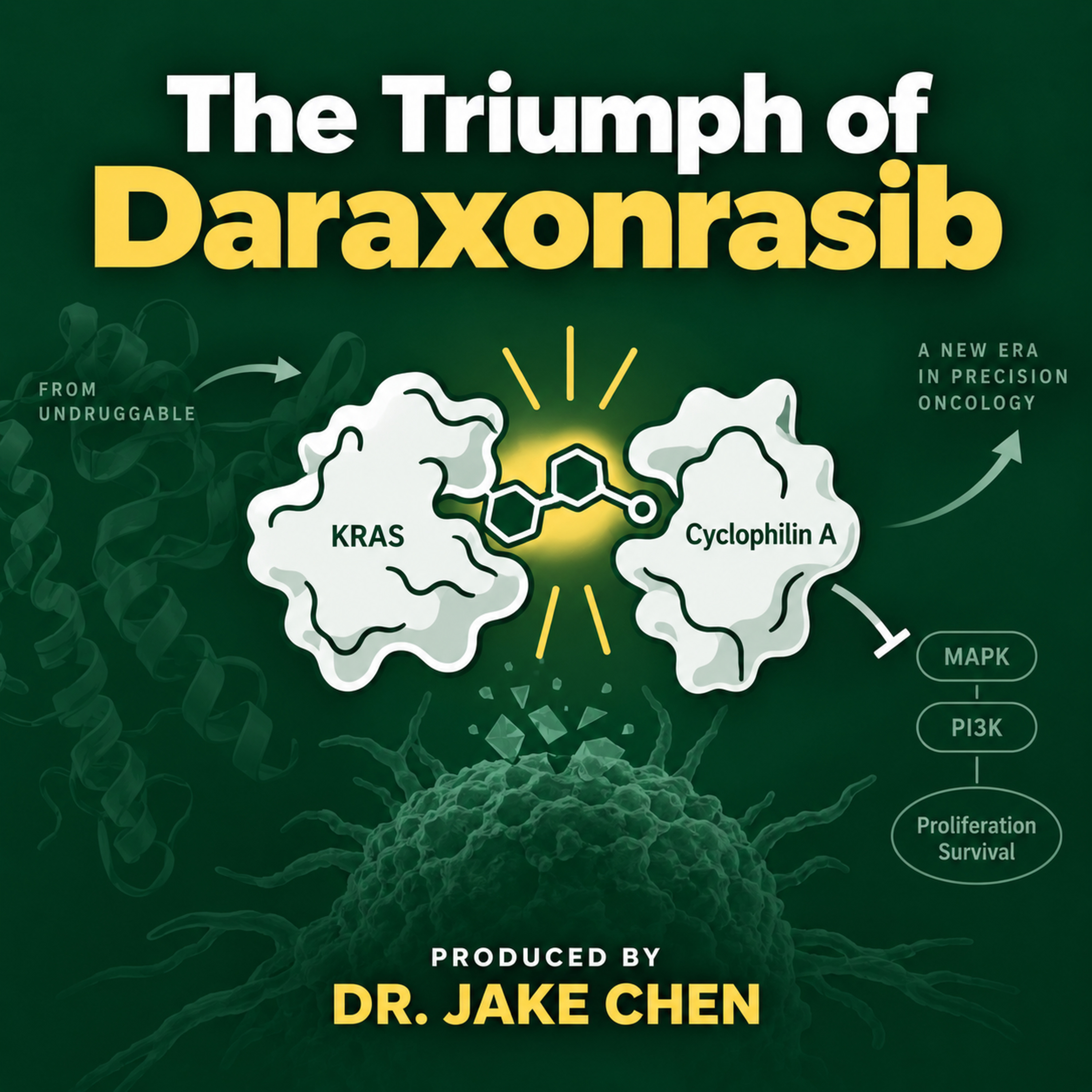 EP 73
The Triumph of Daraxonrasib
This episode explores the breakthrough approval of Daraxonrasib, a molecular‑glue drug that finally targets the once‑undruggable KRAS mutation in metastatic pancreatic cancer. The hosts discuss its mechanism, resistance strategies, and how AI is reshaping drug design and early detection.
KRASmolecular gluepancreatic cancerAI drug discoveryearly detection
Key Concepts
Molecular Glue Mechanism
- Daraxonrasib first binds cyclophilin A, creating a heterodimer that fits the smooth KRAS surface.
- The resulting complex blocks KRAS signaling across multiple mutant variants.
Resistance Pathways
- KRAS amplification overwhelms drug binding capacity.
- Up‑regulation of alternative growth drivers such as MYC and RTKs provides bypass routes.
Combination Strategies
- DDR inhibitors exploit replication stress caused by KRAS amplification.
- HER2‑targeted antibody‑drug conjugate (TDXD) leverages drug‑induced HER2 expression on pancreatic cells.
AI‑Driven Drug Design
- Deep learning models predict protein‑protein interfaces for molecular glues and PROTACs.
- AI accelerates discovery of compounds that can bridge two proteins without off‑target effects.
Early Detection & Proactive Medicine
- Full‑body MRI combined with an 80‑plus biomarker panel enables detection of millimeter‑scale pancreatic lesions.
Episode Summary
- check_circleFor decades KRAS mutations in pancreatic cancer were deemed undruggable due to a smooth protein surface lacking pockets.
- check_circleDaraxonrasib was fast‑tracked by the FDA after phase 3 RSLUT302 showed median overall survival doubling from 6.7 to 13.2 months.
- check_circleThe drug works as a molecular glue: it first binds cyclophilin A, forming a complex that can latch onto active KRAS and shut down signaling.
- check_circleThis approach enables activity against multiple KRAS variants, including the common G12D and G12E mutations.
- check_circleMolecular glues and PROTACs represent a paradigm shift in drug discovery, both relying heavily on AI for protein‑protein interface design.
- check_circleResistance mechanisms observed include KRAS gene amplification and activation of alternative pathways such as MYC and various RTKs.
- check_circlectDNA monitoring revealed no secondary KRAS mutations but identified amplifications and pathway switches in 59% of resistant patients.
- check_circleCombination strategies to overcome resistance were tested in xenograft models: DDR inhibitors exploit replication stress; HER2‑targeted ADCs (TDXD) exploit drug‑induced HER2 up‑regulation; dual KRAS inhibition with Zoldenrasib blocks escape routes.
- check_circleDespite survival gains, pancreatic cancer remains a disease of months, highlighting the need for earlier detection.
- check_circleEarly detection initiatives like Ahead Health’s AI‑driven full‑body MRI and 80‑plus biomarker panels aim to catch disease before metastasis.
Full Transcript
Discussion
Join the discussion — sign in to leave a comment.
Log in to comment