arrow_backAll episodes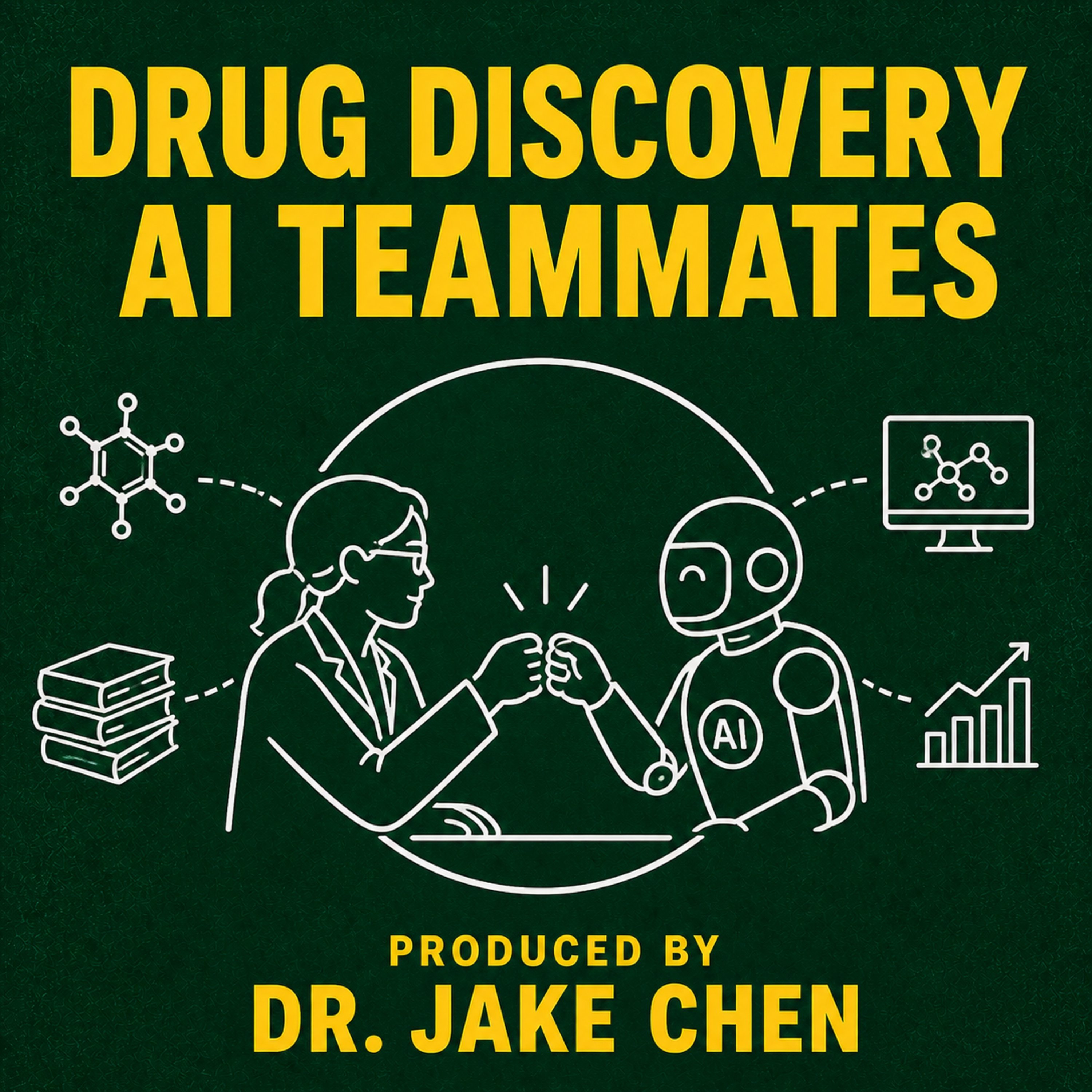 EP 59
EP 59
Drug Discovery AI Teammates
The future of AI-enabled drug discovery is about massive human teams working seamlessly alongside specialized autonomous teams of AI agents. This episode explores the paradigm shift in drug discovery, from the traditional model of a single principal investigator to a dynamic teaming approach. The discussion delves into the complexity gap in modern drug discovery, the role of AI in bridging this gap, and the importance of human-AI collaboration.
drug discoveryAIhuman-AI collaborationdynamic teamingagentic AIexplainable AInew approach methodologies
Key Concepts
Dynamic Teaming
- The team itself becomes the brain, and AI agents support this brain with three pillars: managing power dynamics, handling data, and ethics.
- Dynamic teaming relies on a multilevel scaffold, where the team is treated as an emergent cognitive unit.
- The Bridge to AI consortium has pioneered the concept of dynamic teaming, and has developed a framework for implementing it in practice.
Agentic AI
- Agentic AI is a new approach to AI, where a team of specialized AI agents break down problems into subtasks.
- This approach is different from traditional AI, where a single AI brain tries to do everything at once.
- Agentic AI is more effective in complex, dynamic environments, where multiple tasks need to be performed simultaneously.
Human-AI Collaboration
- Human-AI collaboration is critical in drug discovery, where AI handles repetitive, data-heavy tasks, and humans provide nuanced judgment and interpretation of complex biological phenomena.
- The human team provides the biological intuition to understand outliers, and the AI team provides the computational power to analyze large datasets.
- The fusion of human and AI teams enables the development of more effective treatments, and improves the efficiency of the drug discovery process.
Explainable AI (XAI)
- Explainable AI is critical in highly regulated medical fields, where transparency and explainability are paramount.
- XAI enables the development of trust in AI systems, by providing insights into the decision-making process.
- The FDA and EMA have released collaborative frameworks demanding detailed, traceable records of training data for GXP compliance.
New Approach Methodologies (NAMEs)
- The ultimate goal of NAMEs is to eliminate animal testing entirely, replacing it with highly accurate AI-driven human cell models and organ-on-a-chip systems.
- NAMEs have the potential to revolutionize the drug discovery process, by providing more accurate and efficient testing methods.
- The development of NAMEs requires the collaboration of multiple stakeholders, including regulatory agencies, industry, and academia.
Episode Summary
- check_circleThe traditional model of drug discovery is no longer sustainable, with a 90% failure rate and a decade-long process.
- check_circleThe pharmaceutical industry has recognized the need for a new approach, leveraging massive amounts of computing power and AI to improve the discovery process.
- check_circleThe future of AI-enabled drug discovery is about human teams working alongside specialized autonomous AI agent teams.
- check_circleDynamic teaming is a key concept in this new approach, where the team itself becomes the brain, and AI agents support this brain with three pillars: managing power dynamics, handling data, and ethics.
- check_circleThe Bridge to AI consortium is a $130 million initiative that aims to generate ethical, AI-ready data sets, and has pioneered the concept of dynamic teaming.
- check_circleAgentic AI is a new approach to AI, where a team of specialized AI agents break down problems into subtasks, rather than a single AI brain trying to do everything at once.
- check_circleTIPI is a technical system designed for laboratory automation, which uses a microservices setup via the Model Context Protocol (MCP) to enable secure communication between AI agents.
- check_circleThe fusion of human and AI teams is critical in drug discovery, with AI handling repetitive, data-heavy tasks, and humans providing nuanced judgment and interpretation of complex biological phenomena.
- check_circleThe black box problem is a significant hurdle in deploying AI in highly regulated medical fields, where explainability and transparency are paramount.
- The FDA and EMA have released collaborative frameworks demanding detailed, traceable records of training data for GXP compliance.
Full Transcript
Discussion
Join the discussion — sign in to leave a comment.
Log in to comment