arrow_backAll episodes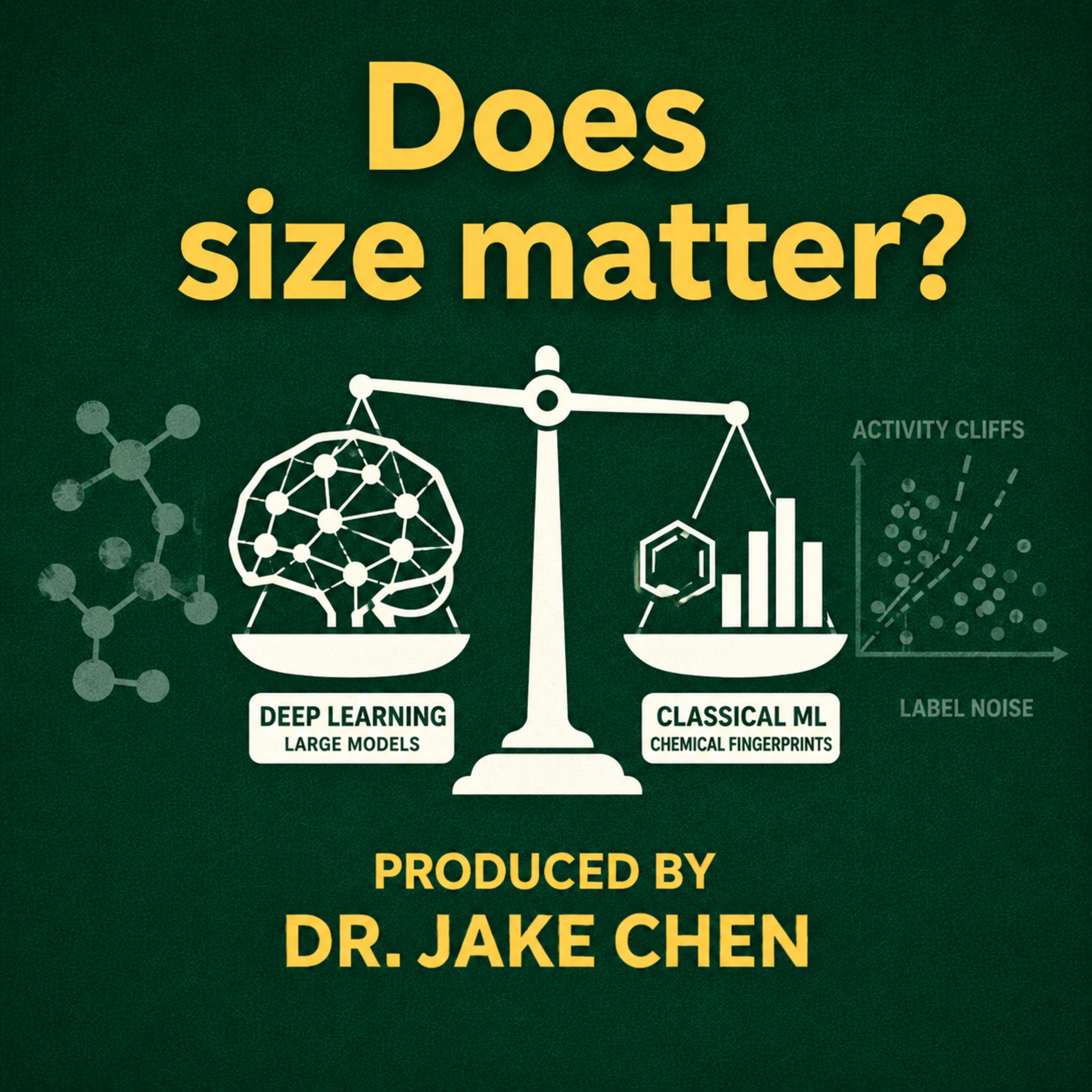 EP 67
EP 67
Does Size Matter?
The podcast discusses the role of large foundation models in drug discovery, comparing their performance to classical machine learning models. The conversation highlights the challenges of working with small, noisy datasets and the importance of understanding the topology of chemical space. The episode explores the trade-offs between exploitation and exploration in drug discovery, and how different models can be used to achieve these goals.
AIdrug discoverymachine learningfoundation modelsclassical machine learning
Key Concepts
Activity Cliffs
- Small changes in molecular structure can lead to large changes in biological activity.
- Foundation models struggle with activity cliffs because they are designed to interpolate smoothly between data points.
- Classical models are better suited to handling activity cliffs because they can make discrete decisions based on specific features.
Inductive Bias
- The inductive bias of a model refers to its tendency to prefer certain types of explanations or solutions.
- Understanding the inductive bias of different models is crucial for understanding their strengths and weaknesses.
- Different models have different inductive biases, which can impact their performance in different tasks.
Omitted Variable Bias
- Omitted variable bias occurs when a model is misled by missing information in the data.
- This can happen when a model is trained on a dataset that is missing important features or information.
- Omitted variable bias can lead to poor performance and incorrect conclusions.
Exploitation vs. Exploration
- Exploitation refers to the use of a model to make predictions or take actions in a familiar context.
- Exploration refers to the use of a model to learn about new contexts or to discover new information.
- Different models are better suited to either exploitation or exploration, depending on their design and strengths.
Classical Machine Learning Models
- Classical machine learning models, such as random forests and XGBoost, are often outperforming foundation models in certain tasks.
- These models are well-suited to handling small, noisy datasets and can make discrete decisions based on specific features.
- Classical models are often more interpretable than foundation models, which can make them easier to understand and work with.
Episode Summary
- check_circleLarge foundation models are being used in drug discovery, but their performance is hindered by small, noisy datasets.
- check_circleClassical machine learning models, such as random forests and XGBoost, are often outperforming foundation models in certain tasks.
- check_circleThe topology of chemical space is complex, with many local irregularities that can make it difficult for foundation models to generalize.
- check_circleThe concept of 'activity cliffs' is introduced, where small changes in molecular structure can lead to large changes in biological activity.
- check_circleFoundation models struggle with activity cliffs because they are designed to interpolate smoothly between data points.
- check_circleClassical models, on the other hand, are better suited to handling activity cliffs because they can make discrete decisions based on specific features.
- check_circleThe importance of understanding the inductive bias of different models is highlighted, and how this can impact their performance in different tasks.
- check_circleThe concept of 'omitted variable bias' is introduced, where models can be misled by missing information in the data.
- check_circleThe need for a more nuanced understanding of the strengths and weaknesses of different models is emphasized, and how they can be used in combination to achieve better results.
Full Transcript
Discussion
Join the discussion — sign in to leave a comment.
Log in to comment